
Our first day at the Monday market in Borgotaro, I spotted a beautiful pile of apples. The sign read €3.99. I thought to myself: apples can be cheaper than that in the US, but these are really gorgeous apples.
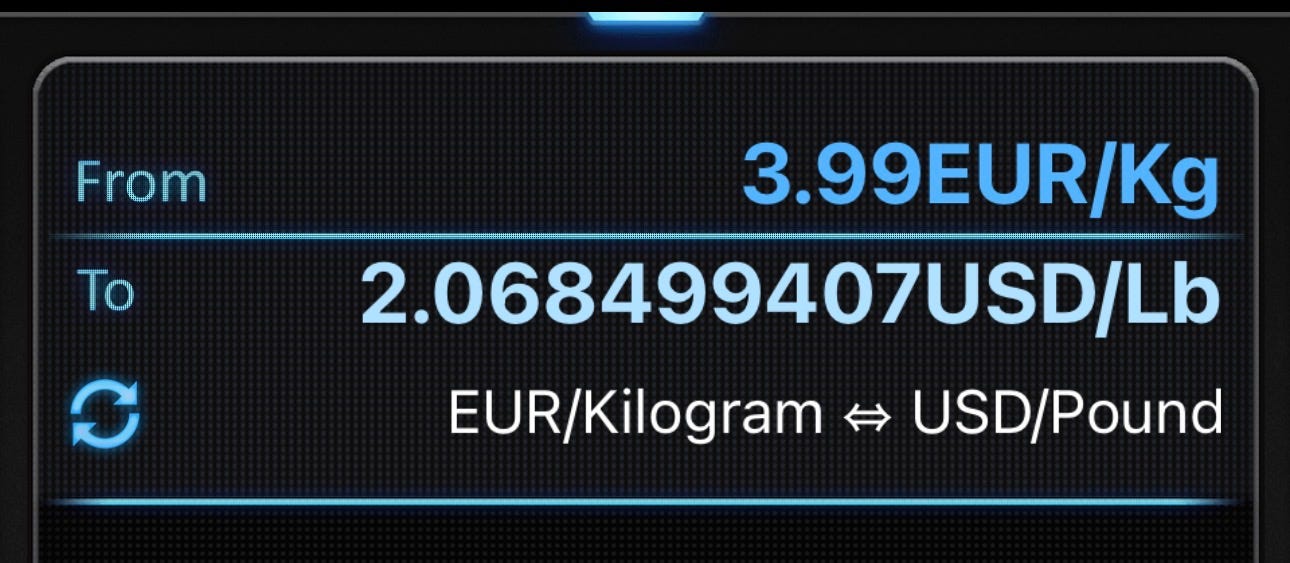
It took me a second, maybe two, before the obvious hit me. I was looking at €3.99 a KILO for apples, not per pound. Once I did the actual math, those really beautiful apples were about $2.07 a pound (as I write this of course). Those apples at the supermarket in the weekly €1 special? Those were less than fifty cents a pound! I’d say those were pretty inexpensive apples!
That moment in the market is a perfect metaphor for cost comparison between the US (in my case) and Italy. The price tags were telling me a truth, but it wasn’t the full truth without both converting pounds per kilo (2.2) and US Dollars per Euro. That varies by the day, week, month and year. Now, you might wonder why I constantly talk about “conversion rates”. That’s because the vast majority of our income is in US Dollars. We do have some Euro income from some small business endeavors, but we rely on US Dollars for our survival, so we are always thinking about “how much is that in OUR money”!
The Kilo vs Pound Recalibration
We’ll continue at the market for a minute, because it’s a very common occurrence. Our weekly market happens on Mondays, but shopping for food can happen just about any day (and in fact, we often end up shopping every single day!).
Pricing in Italy at the market or the deli counter are usually priced “per etto” - (100 grams), or per kilo (1,000 grams, or 2.2 pounds). So how did I figure out how much those apples were in US Dollars (at that current day’s exchange)? I could tell you that I did some awesome mental math, but I only do that when the exchange rate is close to par (more on that in a minute). You do eventually stop converting every little thing. That adjustment usually really takes a full year of seeing prices change with the seasons. You know that €3.99 for those Fugi apples in May is a really good price, and that when the tomatoes are on sale in the summer for as little as €1.00, you’ve got yourself a steal. You build your new internal price compass.
Until then, get a universal unit converter. The one I have is Unit Converter ∞ it costs about $2.99. It hasn’t been updated in 8 years, because honestly, it’s not really necessary to update! But it DOES still do a daily currency update. So you could go get that one if you have an iPhone, or just look around the App/Play Stores for something that “converts everything”. This one can literally put in a € cost per kilo and it will spit out the current $ cost per pound.
The Currency Framing Problem
Before you even get to the price tags, there’s the currency itself. Americans living abroad, particularly those who moved here without deep prior international experience, tend to set the euro-to-dollar exchange rate in their heads at whatever it was when they arrived, and make their internal calculations based on that point of reference. This is a mistake that can hide the true cost of items in subtle ways.
Our rent, for example, is €300 per month. (Yes, really.) In euros, that number has not changed. In US dollars, however, it has ranged from a low of $299.98 in October 2022 to a high of $371.02, with a ten-year average of approximately $336.84. The landlord is paid exactly €300 every month. What that costs us in dollars shifts with every movement in the exchange rate.
Many people chat online about the euro to dollar conversion in terms of what a dollar costs in euro. “Today, theUS Dollar costs €0.8678.” To me, that’s backwards for those of us who are dependent on the US Dollar for our survival (which is, of course, what I teach in my course - getting paid in USD to live abroad). To buy a US Dollar might cost 0.8678 Euro. But that’s not how we think. We are thinking about how many US Dollars (or your currency of choice) does that Euro price cost me. So I want to know that a Euro costs me $1.1523. When you look at it this way, it’s easier to see your real costs. If something is €1, it’s going to cost me $1.15.

If you’re from the USA, you’re probably used to price tags that don’t tell the complete story — the sales tax gets added at the register. In Europe, the VAT is already in the price. What you see is what you pay.
This matters more than you might realize when comparing costs across the Atlantic. In the US, the sticker price is an “estimate” — the real price appears at the register. In Europe, the VAT is already in the number you see. So there’s actually a point where the exchange rate makes European prices one-to-one against American prices. We can use the same scale with no mental math required. Taking into account that different States exempt different things from sales tax, we’ll just generalize here. Check your state’s combined sales tax rate here. When the dollar-to-euro rate roughly matches €1 plus your home state’s sales tax burden in cents, you can look at a €2.50 pack kleenex and honestly compare it to a $2.50 pack of kleenex.
We split our US time between Tennessee, Washington State, and Colorado. They have combined Sales Tax Rates of 9.61%, 9.51% and 7.89% respectively. So averaging those, for us, that crossover point is around $1.09 to the euro. As of this writing we’re at around $1.15, so European prices are running about 5% higher than a direct number-for-number comparison would suggest — but we’re at least able to do a valid comparison. If a product costs us €1, and the US Dollar price of a Euro is $1.09, then it directly costs us $1. That’s a calculation we can make in our heads (or actually looking up prices if we’re that interested), to see if a product is costing us more or less in Italy than in the US.
Track the exchange rate. Not obsessively, but enough to know when it’s moved meaningfully. It is a cost of living that most Americans genuinely underestimate when they’re planning a move abroad.
A Liter Is Not a Gallon
Just as trying to compare euro price per kilo requires some serious mental math (or a calculator), comparing gasoline pricing in Italy per liter, in euros can give you a headache when trying to figure that out in dollars per gallon. Let’s just say that generally speaking, gasoline is a lot more expensive in Europe than in the US. Fill up your car, figure out how far you can drive on a tank, and stop trying to figure out the price per gallon. Most Italians drive smaller, more fuel-efficient cars than Americans are accustomed to, and many rely on regional trains and local transit in ways that Americans in car-dependent suburbs simply cannot replicate. Just know that it costs about €6.50 to drive to Parma, and you won’t have to stress so much over the conversions.
What Prices Actually Mean Here
One of the more pleasant surprises for most Americans in Italy is price transparency. When something costs €14.99, it costs €14.99. Our mobile phone plans are €14.99 per month each. Not €14.99 plus a regulatory recovery fee, plus a network access charge, plus a line maintenance fee, plus government surcharges, plus whatever else has been invented since last quarter. Just €14.99.
For comparison: we share a T-Mobile plan in the US with our two children, plus an Apple Watch. The base plan runs approximately $115 monthly — around $25 per line (plus a $15 watch), which is actually reasonable by US standards. But then there is an additional $36.77 in taxes and fees on top of that every month. It has been $36.77 in add-ons for years.
This is not unique to mobile phones. When we need a new appliance and visit our local elettrodomestici store, the price on the tag includes delivery and installation. In the US, those are typically additional costs.
The same principle applies at restaurants, which I’ll address fully in a separate post on tipping culture. The short version: service is included in what Italians pay their employees, so the menu price is the price you pay, full stop. No 20% assumption built into every dining decision. That alone changes the economics of eating out in very real ways.
The Costs That Will Actually Surprise You
Not everything is cheaper in Italy. Some things are surprisingly more expensive to Americans. The Italian driver’s license situation is a prime example.
If you move to Italy from the United States, you cannot exchange your American license for an Italian one. Unlike licenses from many EU countries and a handful of others, the US has no reciprocal agreement with Italy. You will need to start the process from the beginning, which currently looks something like this:
Autoscuola enrollment: taking classes will cost you typically €200–€400
Mandatory driving lessons: a minimum of 8 hours is now required by law, at approximately €40–€60 per hour, so over €400 just for the minimum
Medical examination: €40–€80
Administrative and government stamp fees: approximately €100–€150
Theory exam: €30–€150 depending on how it’s administered
Practical exam: a fixed €275 per attempt
Add all of that together before accounting for Italian language lessons (the theory exam is in Italian, German, or French — not English), additional driving hours if you need them, or repeat exam fees if you don’t pass on the first attempt. I’ve heard estimates as high as €3,000 from people who’ve gone through the full process, particularly when language preparation is factored in. My own polling of Americans living in Italy ranges from €600-€ 2499, with 41% saying under €800 and another 55% saying from €800-€2499..
There is also a provisional period following the test, during which restrictions on vehicle horsepower may apply. Depending on what you currently drive, that could mean adjusting what you’re behind the wheel of. It is not a trivial process, and it is not a trivial expense.
Another cost that is generally more expensive is household energy. We use less, so our energy, although outlandishly expensive if you ask an Italian, is 1/3 for our 1000 sq ft apartment than ti was for our 3000 sq ft house (that feels “equal” to us). We use the A/C less (rarely really). We don’t have a clothes dryer or a dishwater. Other than that, our day-to-day life doesn’t feel like we are “using less” energy. So by living more like Italians, we don’t really feel like our energy costs are that expensive.
The Taxes Trade-Off
American’s abroad tend to either gloss over taxes entirely or treat them as a dealbreaker. Neither is accurate.
We pay approximately $3,000-$5,000 more in income taxes per year than we would if we were living in the United States. The first year, that caused a real gasp. But then we started looking at what we are not paying in the US that is covered by our taxes.
We pay exactly €0 for national health insurance (newcomers to Italy, depending on Visa, will need to pay €2000 per year to be in the SSN). In the US, that coverage was costing us $400 per month — $4,800 per year. Our actual out-of-pocket costs for medical care in Italy over the past decade have been, for all practical purposes, zero, even with numerous tests, surgeries and cancer treatment.
If you have children (or you yourself are University aged), University tuition averages in the €2000 per year range. This does not include housing, but Italians often live with their parents while studying at University. We see buses and trains full of university students heading to Parma (a hour) or Bologna (2-1/2 hours) every day. So the cost of education is very low in Italy, compared to the US.
So: we pay more in income taxes. We pay nothing for health coverage. Education costs are minimal. In fact, University education here isn’t much more than I paid in the University of California system 45 years ago. All of that seems to offset the income taxes that are higher, but fund infrastructure we use.The net result for us is a meaningful financial improvement over our US situation. Your math will depend on your income level, your specific health situation, whether you have children, and which region of Italy you’re in. It is absolutely a landmine worth mapping carefully before you make any decisions — but it is not automatically a negative.
The Final Recalibration
In the end, the real adjustment isn’t actually about arithmetic. Instead it’s about rethinking what things “should” cost, and building a new baseline for your daily life and expenses. Some of what costs more actually buys you something real that you didn’t even know you were missing out on.
The numbers will take time to recalibrate, but if you can work on your mindset from the start, the calculations will eventually just fade into the background.
