
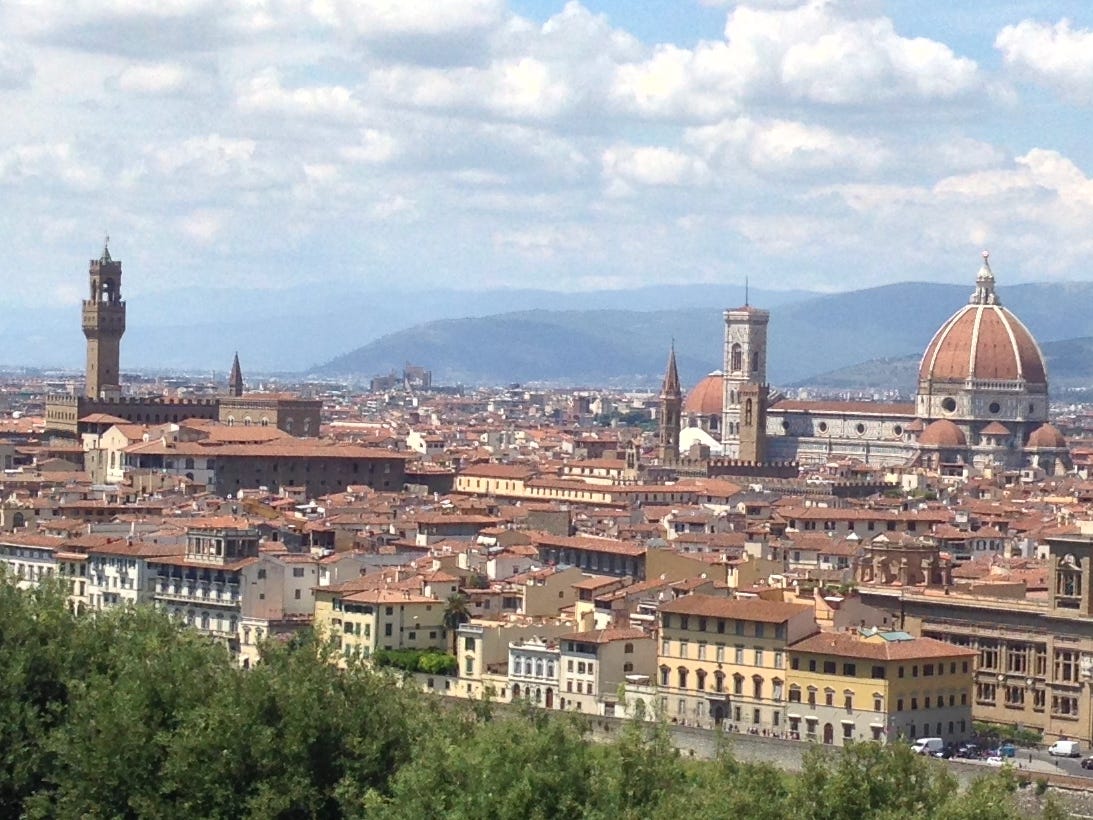
The view from Piazzale Michelangelo over Florence is, objectively, one of the finest in Italy. The kind of view that stops conversation mid-sentence. We were passing through, decided to stop for lunch, and found ourselves at a restaurant with that view, a lovely meal, and one critical tell: we were speaking English.
When the conto arrived, the waitress asked us — casually, as if it were a perfectly normal question — whether we'd like her to add a tip to the card total.
I looked at her directly and replied, in Italian: "È una domanda un po' maleducata, non credi?" — "That's a rather rude question, don't you think?"
"Ah signora, mi dispiace tanto."
She was very sorry indeed.
Had we been speaking Italian, she never would have asked.
That story tells you most of what you need to know about tipping in Italy. But since I've been collecting these moments for over a decade, let me give you the fuller picture — because Americans visiting or worse, moving to Italy, get this wrong with remarkable consistency, and the consequences extend beyond your own dining bill.
What Italians Actually Do
A lot of tourist content hedges here, so I won't: Italians do not tip. Not in the way Americans understand the word.
When Italians finish a meal at a restaurant, they pay the conto. If they happen to have exact change, they leave exact change. If they don't, they might leave a euro or two on the table — what an Italian would call arrotondare, just rounding up. This is not a tip in the American sense. It's what happens when your bill is €38 and you're handing over two €20 notes.
If the bill comes to €38 and you hand over €50, an Italian will either wait for the change or ask for it. They will not say "keep it."
Someone at this point will inevitably say: "But I always tip when I'm in Italy, and the servers are always so appreciative!" Of course they are. Italy is not a culture that considers a tip an insult. They would have been equally pleasant as you left without one. A waiter being genuinely appreciative of a tip is not the same thing as a waiter expecting or needing one.
Two Things That Are Not Tips
The coperto deserves its own moment here, because it causes genuine confusion. You'll see a coperto charge on most Italian restaurant bills — typically €1–€3 per person. This is not a cover charge in the American nightclub sense. It's essentially payment for the table setup: the tablecloth, the cutlery, the glassware, and the bread that arrives at the table without your asking for it. It is a normal and transparent part of dining in Italy, it appears on the menu, and it is emphatically not a tip. Pay it, eat the bread, and don't overthink it.
The coperto actually is frequently reflected in the difference between what you pay drinking your coffee at the bar, and sitting down at a table. If you see a price list that says "al banco", this is a clue that if you sit at a table you will likely be charged MORE than at the bar. Sometimes this really is just a function of the coperto. At other locations it will mean that even the actual prices of the items will increase when enjoyed at the table. A little aside anecdote, in our town, only one location charges more at the table than at the bar. This is a bar/gelateria (arguably the best gelato in town), and they charge more at the table ONLY for gelato. I assume it's because they have to wash those cute little bowls they serve the gelato in. We don't pay more for a cappuccino and cornetto when we stop in there for a Sunday morning breakfast!
The servizio is a service charge that appears on some restaurant bills, particularly in tourist areas. If a servizio charge is on your bill, it is because the establishment has put it there — it is not an invitation to add a further tip on top of it. Italians who encounter a servizio charge will pay it, because it's on the bill, and then perhaps round up by a euro. That's the ceiling. The servizio might be a fixed price, or a percentage. You are surely in a larger or more touristy location if there is a servizio on the bill.
So reminder: if a waiter in a tourist area offers to add a "gratuity" to your card total, understand clearly that he is not making this offer to the Italian couple at the next table. He is reading your accent and your tourist-shaped body language. You are under no obligation to accept, and a polite decline — ideally in Italian — is entirely appropriate.
Where Tipping Does Actually Happen
There are a handful of categories where some form of gratuity is genuinely customary, even among Italians:
Tour guides. If you've done a half-day guided tour and the guide was excellent, €5 is appreciated and appropriate. For a full-day tour, €10 is generous and warmly received. This is one area where Italians themselves will tip, because a guide's livelihood depends more directly on it than a restaurant waiter's does.
Bellhops. If someone carries your bags to your hotel room, a euro or two per bag is fine and expected. This is an explicitly rendered service in exchange for a small acknowledgment.
Taxis. Rounding up to the nearest euro or two is the standard Italian practice. Handing a driver €12 for an €11.40 fare is perfectly normal. Calculating a percentage tip on top of the metered fare is not.
Hotel housekeeping. Not standard practice in Italy. Not expected.
That, genuinely, is the list.
Three Moments
I shared the Florence story above. Here are two more.
During what I refer to as my Rome Covid trip (a full story in another post), I was with a group of about 18 people at dinner. No one ordered more than a first or second course, but there was wine — there is always wine. The total came to just under €400. Everyone handed approximately €25 to our group leader, and his wife quietly began returning €1–€2 to each person, because — and I will not forget the way she said this — "sarebbe assurdo lasciare più di una mancia di €20." It would be absurd to leave more than a €20 tip. On a €400 bill, for 18 people. That is 5%, and she considered it the outer limit of what made sense.
Just a couple of months ago, we celebrated my Italian citizenship with a dinner party of about 15 people. Before we left, even after 10 years my American doubt took over, and I leaned over to my trusted Italian friend and asked, quietly, whether we should leave something for the staff given the size of our group. She shook her head. "I camerieri vengono pagati — non hanno bisogno della mancia." The waiters are paid. They don't need a tip.
These are not isolated anecdotes. This is consistent Italian social behavior across a decade of observation, across different regions, different contexts, different price points.
The Case Against Being "The Generous American"
When Americans travel to Italy and tip lavishly — because it feels natural, because generosity is the intent, because it feels awkward not to — they are not simply being kind. They are participating in an economic distortion that the local economy did not invite and does not benefit from.
My husband Joe worked in Aberdeen, Scotland during the North Sea oil boom. American oil workers flooded in with salaries and per diems that dwarfed local incomes. They bought rounds for the bar. They tipped extravagantly. They were, by their own lights, being generous. Establishments noticed. Prices started to creep upward — not dramatically at first, just a little — because the market had discovered there was spending capacity in the room. When the oil workers eventually went home, the prices did not follow them back down. Locals were left paying more for the same pint they had always ordered, in the bar they had always used, because someone else's generosity had reset the baseline.
Italy is not an oil boom, but international tourism creates a structurally similar economy when visitors spend in ways that distort local pricing norms. The affordable neighborhood trattoria that has been feeding the same families for three generations stays affordable because it prices for those families, not for a tourist who considers €25 an obvious bargain for a meal. When outside money tips that balance (literally and figuratively) it rarely tips it in ways that benefit the locals who built the culture that made Italy worth visiting.
The American restaurant service situation is truly bizarre to most foreigners. The idea that servers might be paid next to nothing (or truly just nothing) other than tips is hard for outsiders to understand. Try not to bring that comparision to Italy. Are Italian waiters underpaid? By American "server tip earnings" standards, possibly. Just remember that the cost of living in Italy is, for the most part, a lot less than in the US. Our bars and restaurants are lively, often close to overcrowded. That's because the average worker in Italy can enjoy this vibrant part of our culture on the income made by the average worker in Italy!
Tip your tour guide generously. Acknowledge the bellhop. Round up in a taxi if you'd like. But leave the 20% American reflex in the US, where it genuinely funds the income of workers who depend on it structurally. In Italy, it isn't needed, it isn't expected, and at any meaningful scale, it causes real harm.
