
In my previous post, Cancer, Rome, and the Covid Plot Twist, I told the story of my cancer diagnosis and its rather unfortunate Covid timing. Now it's time to recount the actual surgery "adventure" — and yes, I am using that word completely intentionally.
Apparently, my Roman misadventure had caused something of a shakeup for my surgeon. I was called in for a final pre-surgery meeting, and the surgeon waiting for me was not the one I’d been seeing. My original surgeon was a woman; this one was a man. I’m not certain he was younger, but he was definitely handsome. Joe jokes that I choose doctors and dentists based on their looks — and I can’t entirely argue the point. Our family doctor and dentist back in the States, both of whom we’ve known for 45 years, are both quite handsome, as is our medico di base (primary care physician) in Italy. But looks are not the primary consideration when choosing medical professionals — let’s just say I’ve been well-blessed in that department, and leave it there.
Getting There: The Logistics of a Covid-Era Surgery
By the time I needed this surgery, we had lived in Italy for six years. As I’ve mentioned more than once: we don’t own a car. Most of the time this is completely fine. Early Parma appointments — like getting to the questura in time to queue for a number — require an early train or bus, but if we need to arrive roughly at or after 7:30 am, public transportation manages it adequately enough.
My surgery schedule was not going to be so accommodating. Because Covid restrictions were still in effect, I needed to be in Parma at three separate times across three days:
Monday: At Ospedale Maggiore di Parma by 8 am for pre-op
Tuesday: Back by 11 am for a Covid-19 test
Wednesday: Checked in by 7 am for surgery
While it’s roughly an hour to Parma by train or bus, getting to the hospital adds another 30 minutes (train plus bus, or train plus a serious walk) — each way. And the train schedules were not designed with surgical pre-op times in mind.
I had a solution: a “surgery vacation.” If you’ve read my language test vacation post, you’ll know that Joe and I have a well-established habit of turning otherwise bureaucratic (or, in this case, genuinely stressful) events into something resembling a romantic getaway. We committed to the challenge again, and rented an AirBNB within walking distance of the hospital for three nights, turning the whole thing into a Parma adventure.
The Required Ethnic Food Research
Living in a small mountain city that, at the time had zero ethnic restaurants (we now have a sushi restaurant and a pizza-and-kebab spot, which feels like genuine metropolitan progress), our trips into any “big city” tend to involve enthusiastic searches for food we simply cannot get at home. So before leaving, we made reservations at an Argentinian restaurant for Sunday night and an Indian restaurant for Monday night.
We arrived Sunday afternoon, found our home for four nights with only a little confusion, got a bit of work done (motto: have internet, will travel), and that evening we went for Argentinian BBQ. I was pleased to see guacamole, chips, and a genuinely good margarita for those of us who occasionally miss certain North American staples. I honestly have no idea if chips with guacamole and a margarita on the rocks are typical Argentinian fare, nor do I care!
Monday morning’s pre-op appointment was brief. Afterwards, we walked through Parco Ducale, one of my favorite spots in Parma, I once again got some work done in the afternoon, and then that evening, we walked down Viale Piacenza to the Indian restaurant. A note on ethnic restaurants in Italy: they tend to calibrate heat and spice to local tastes, which in many areas of Italy means considerably gentler than the source cuisine. “Spicy” at most ethnic restaurants in Italy means something you might politely describe as warmly flavored. This particular Indian restaurant, however, brought me extra spicy sauces unprompted when I asked for heat.
The Test, the Prosecco, and the Vigil
Tuesday was the Covid-19 test. As an aside, my first Italian medical experience had been in 2020, fully in the throes Covid-19 “we don’t even know what we’re up against” protocols, and my Covid-19 test then had consisted of arriving at the local Borgotaro hospital at 7 am for a test, and staying there mostly all day (I think I was released at 2 pm) while they awaited my results. I was then told to go straight home and not be in contact with anyone other than my husband until I arrived at the hospital the next morning for the procedure. This time it wasn’t so regimented.
A fairly large group of us lined up outside the testing building on the hospital complex — and I do mean complex. Ospedale Maggiore is enormous: less like a single American hospital building and more like a college campus, with multiple structures connected by tree-lined roads and dotted with small bars. (Is this common in Italy? In the US? I genuinely don’t know.)
We were called in one by one, tested, and sent home to wait with the now-familiar Covid-era message: if there’s a problem, we’ll contact you; otherwise, show up as scheduled. On the way back to the AirBNB I stopped at one of the bars along the tree-lined access road opposite the hospital for a prosecco — a not-so-stiff drink to mark the occasion — before walking back to tell Joe that I was cleared for the next morning. We had a local dinner, watched TV and tried to get an early sleep. I will admit that I slept better than anticipated. I’m not so sure about Joe!
Wednesday: Surgery Day
Since I couldn’t eat or drink before surgery, Joe walked me to the hospital, with plans to peel off to find a bar for his morning cappuccino and brioche (cornetto to those south of Emilia-Romagna I think). I appreciated both the company on the walk and his good sense about breakfast.
There were other women waiting for their surgeries whom I recognized from previous appointments. We had seen each other in the waiting room outside the surgeon’s office, and again in the department where we had each gone to have a radioactive seed inserted. We had come to know each other by sight, even if none of us had ever exchanged names.
About ten of us sat in the pre-op waiting area, being called in one by one. When my name was called, Joe kissed me goodbye and promised to be back before 2 pm — my scheduled discharge time.
The Compression Stockings (and the Slippers I Did Not Bring)
I was moved into the room that would also be my recovery room. Organized as I am, I immediately clocked the outlet near my bed (phone charging confirmed) and tucked my phone into the drawer of the bedside table for later. A nurse arrived, took me to another room, and proceeded to tut about the fact that I had not brought slippers. (Who knew? No one told me!) She then wriggled me into thigh-high compression stockings. She sent me back to my room barefooted, with an air of mild but lingering disapproval.
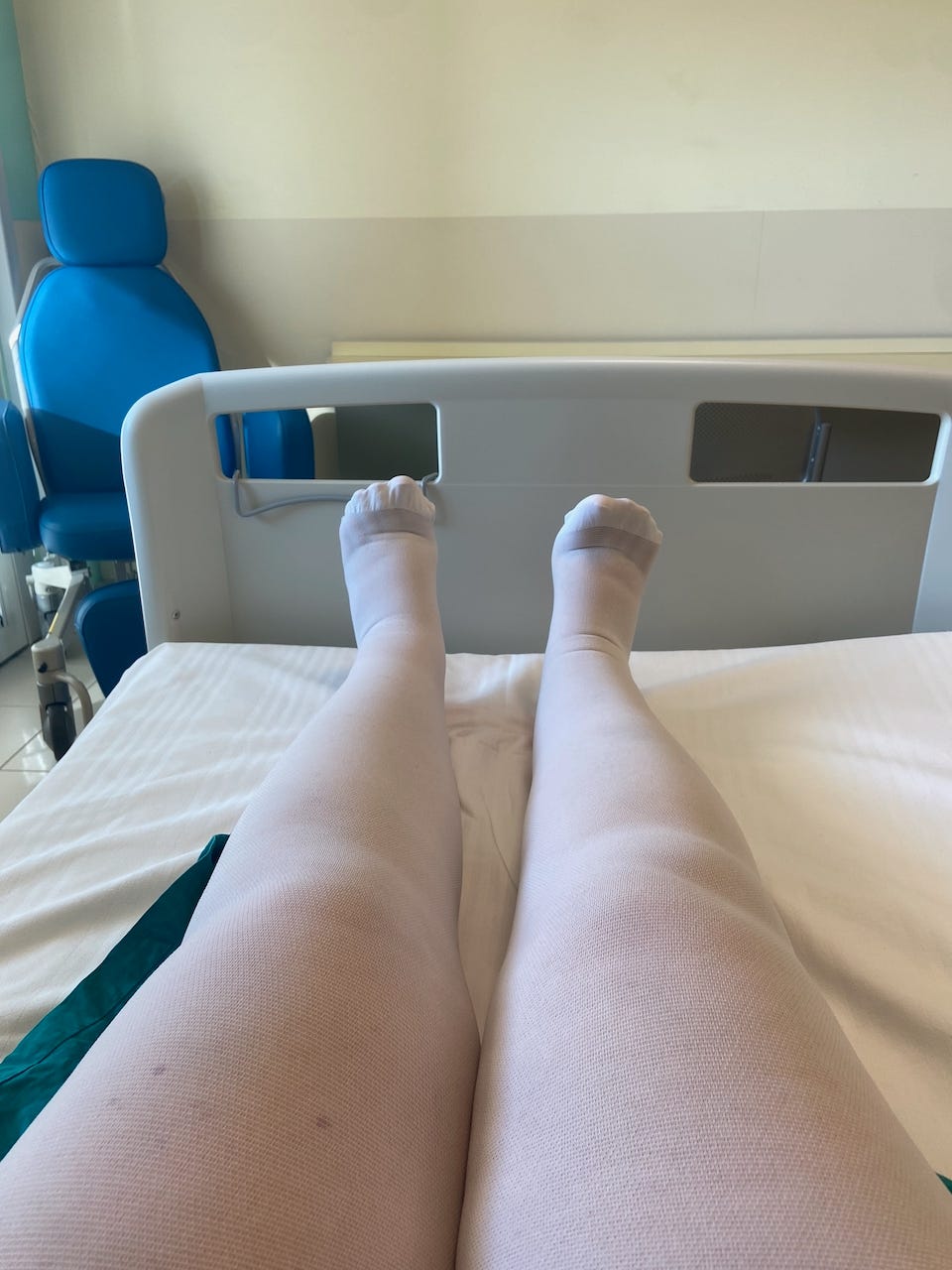
Spoiler: I brought slippers to my lymph node biopsy a few weeks later. Lesson thoroughly learned.)
Eventually, I was rolled into what I can only describe as a pre-op staging area: a room with wheeled beds separated by curtain partitions, similar to a post-colonoscopy recovery space I remembered from Colorado. As I waited, a door directly in front of me opened briefly, and I caught a glimpse of one of the women I recognized from the waiting room — sedated on an operating table.
The sight didn’t disturb me, although I know it would disturb some people. For me it was almost an out-of-body experience, watching and thinking, quite calmly: that will be me soon. I’ve turned that reaction over a few times since. I think I was very solidly in “just get through this” mode, and there simply wasn’t room for extra anxiety.
The Operating Room and the Not-Quite-Under Moment
When it was my turn, my cot was rolled into the OR. I was asked to move onto the slightly larger operating table. The surgeon smiled and said hello; other people in the room introduced themselves (I remember none of their names — only my surgeon’s); the anesthesiologist said hello; and the lights began to dim.
The next thing I was aware of was a faint sensation of tugging near my breast — not painful, but definitely present. I came back to consciousness with a soft moan. The surgeon was stitching me up.
For what it’s worth, I experienced the same thing a few weeks later during my lymph node biopsy — an awareness returning just before leaving the OR. I’ve had two other surgeries for comparison: a tonsillectomy at age four (I remember absolutely nothing between being asked to count down from twenty to one, and waking in recovery hours later), and a C-section during which I was fully awake and felt pressure and nausea but no pain. This felt somehow deliberate rather than accidental, as though this was protocol. I.e., begin bringing the patient around before leaving the OR in order to assess their condition. I may be completely wrong about this. But it happened twice under the same surgical team, so my working theory is that it wasn’t a miscalculation.
Recovery, Pastina in Brodo, and Joe Gets Lost
They rolled me back to my room. I dozed, woke up, found my phone in the drawer, and messaged Joe.
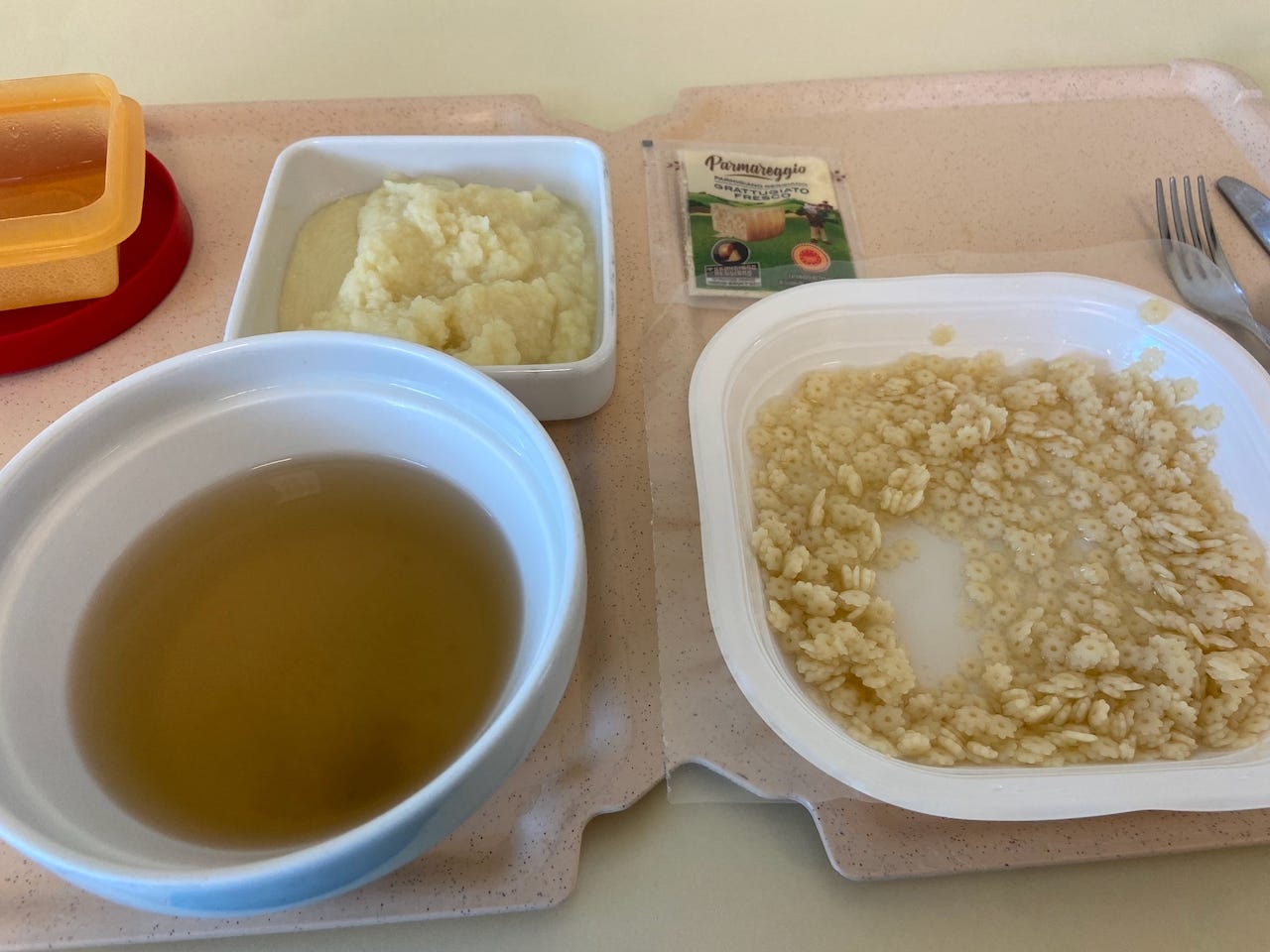
Around 12:30 pm, lunch arrived: pastina in brodo — what Italian-Americans call “Italian penicillin,” the universally comforting small-pasta-in-broth that signals warmth and recovery in equal measure. (Is this actually prescribed as recovery food in Italy, or is that an Italian-American invention? I genuinely don’t know — another question for another post.) Mashed potatoes and Parmigiano Reggiano (of course) rounded out the tray. I was amused, but also starving! I ate it happily.
By 1:30, others were being discharged as their people arrived. Joe messaged me to say he had taken a wrong turn somewhere in the hospital tower and was a bit lost. I was attempting to navigate him through the building by text message, while also noticing that I had suddenly become quite warm.
It was one of the hottest days of the Parma summer — nearly 40°C — but I’d been inside all day and hadn’t registered it until now. In preparation for clearing the ward by 2 pm, the air conditioning had been turned off at around 1:30. It is genuinely remarkable how fast a hospital room heats up when it’s 40°C outside and there is no AC for 45 minutes.
Joe eventually found me and I was discharged. We walked back to the AirBNB, where I slept until the next morning.
Woot.
Starting the Post-Surgery Recovery
About a week after surgery, I had my first follow-up with my surgeon and was referred to my oncologist: Dottoressa Pellegrino, who had done her residency at the Hospital of the University of Pennsylvania (Penn Med) and spoke excellent English. She was, in fact, the first doctor I’d had in Italy who spoke any English at all, and that was an enormous relief.
Fairly early in our relationship, I asked her why she had come back to Italy after her residency, knowing perfectly well that she could almost certainly have earned significantly more money by staying in the US. She answered without hesitation: “I could not in good conscience practice medicine where I could not provide equal care to everyone who needs it.”
Dottoressa Pellegrino saw me through quite a lot over the following two and a half years. Somewhere around our third appointment, she simply switched to Italian — no announcement, no transition, just: Italian. As if to say, you can handle this now, brava. Eventually she told me (in Italian, naturally) that I was doing well enough that I would be moving to her colleague’s care, because there were people who truly needed her expertise. I took it as the positive progression of my treatment it was meant to be, although I still seek her out when I’m at the oncology building just to say hi.
The handoff to oncology began my formal post-op monitoring — five years of ongoing care that, as I write this, is still very much in progress. In the next post, I’ll explain how that actually works in Italy’s healthcare system, and introduce the remarkable volunteers who somehow made the whole experience almost enjoyable.
Continued in The Best Language Lesson I Never Paid For: Discovering the Italian “Taxi Sociale→”
