
(Or: What a Reconnaissance Trip Actually Looks Like)
I'm writing from Italy because that's where I live, but everything here applies whether you're considering Lisbon, Valencia, or a village in the Dordogne.
There is a particular kind of optimism that strikes Americans when they decide to move to Italy. It usually involves a beautiful hill town, a glass of something local, and the absolute certainty that this is the place.
I understand it completely. I have felt it myself.
What I have also felt — and what I want to save you from feeling at the wrong moment — is the gap between a place you love to visit and a place where you can actually live. That gap is measurable. And the best measuring tool available to you is a reconnaissance trip done properly.
Not a vacation. Not a long weekend. A reconnaissance trip.
Here is what that actually looks like.
We Did Our First One in 2014
My husband Joe and I came to Italy two years before we moved. We had been many times before — this was not our first encounter with the country — but this trip had a different purpose. We were not tourists. We were auditioners.
We came to Borgo Val di Taro first (Joe's family name, Zanrè, has roots here — more on that in a moment). Then we checked out Piacenza and Pontremoli. Then south to Lippiano in Umbria, where we wandered around Città di Castello looking, I admit, for the castle (spoiler: not there). Then to Ancona, Pescara, and eventually a tiny mountain village called Castiglione a Casauria, which was beautiful and atmospheric and where it became immediately clear that if you had no family connection there, you probably weren't going to build much of a life there either.
Every single place had something. Every single one.
But in the end, the Zanrè name pulled us back to Borgotaro. Family gravity is real, and we followed it.
Here is what I learned from doing it the way we did: we covered too much ground and stayed too briefly in each place. We were reconnaissance tourists rather than reconnaissance residents. If you do not have a family connection narrowing your search, do it differently than we did.
The Right Way: One Place, 90 Days
If you have the flexibility (and if you are serious about this move, I would argue that creating this flexibility is worth significant effort) spend 90 days in one place.
Not hopping. Not sampling. Ninety days in one town or city, living as close to actual resident life as you can manage.
Here is why 90 days specifically: it spans a season change. When we ultimately arrived in Borgotaro to stay in early May 2016, we were absolutely freezing, having assumed that "May in Italy" meant warmth. It did not. Not in the mountains of Parma. And the shift from mid-September to mid-October — the speed at which the temperature drops, the way the town changes character, the things that close for the season — that is information you simply cannot get from a two-week visit. Climate is not just temperature. It is what daily life feels like when it is cold, or wet, or when the tourist infrastructure evaporates because the season ended.
Ninety days shows you the seams.
What to Actually Do During Those 90 Days
This is not a vacation itinerary. You are testing infrastructure. Specifically:
Transportation: If you are arriving without a car (which many people do, at least initially), map out the public transport options obsessively. Find the bus schedules. Then find the giorni festivi schedules — the holiday timetables — because Italian public transport on feast days can range from "reduced service" to "essentially nonexistent." Find this out before you depend on it.


Food supply chain: Locate your butcher, your produce vendor, your alimentari (the small general stores that are the backbone of Italian daily life), and your nearest supermarket. Then locate the next one. Redundancy matters. Know where you are going when your first option is closed — and things close: for lunch, for holidays, for August, for reasons that will not always be explained to you.
Pharmacy: Find the closest one. Then find the next closest. Then find out what the rotation schedule is for farmacia di turno — the on-duty pharmacy that stays open when the others are closed. In smaller towns this matters more than you expect.


Hospital: Know where it is. Know how far away it is. Know whether there is a pronto soccorso (emergency room) or just a smaller facility. This is not pessimism — it is the same due diligence you would do anywhere.
The tourist office: Go. Seriously. I know it sounds counterintuitive — you are not a tourist, you are a future resident — but the tourist office in a smaller Italian town is often staffed by people who know absolutely everything about the place, speak at least some English, and are genuinely pleased to help someone who is interested in actually living there rather than just passing through. In smaller towns especially, the contact you make at the tourist office can turn into one of your most useful local relationships for years.
A Note on Healthcare Before You're in the System
Here is the honest version of this, because most relocation guides either skip it or oversimplify it:
When you first arrive in Italy on a visa, you will not be eligible for the national health service (Servizio Sanitario Nazionale) right away. Eligibility comes with residency, and residency takes time to establish. In the interim, you are operating privately — which sounds alarming until you understand what that actually means in practice.
We winged it, frankly. We knew that if something serious happened, we would find help — and we were right. Italy does not turn people away from emergency care. But "winging it" is a more comfortable position when neither of you is on routine medications and you are generally healthy.
Before you go, ask yourself two questions:
What medications do you take that a farmacia can fill without a prescription? In Italy, the farmacista is a genuinely skilled professional, not just a dispenser. They handle an enormous range of health questions and minor treatments that would require a doctor's visit in the US. Many things you currently need a prescription for at home are available over the counter here. Know your medications, know their Italian equivalents, and have that conversation at your local pharmacy early.
What will your process be for private doctors and insurance reimbursement? If you carry international health insurance (which you should, at minimum for the transition period), understand exactly how the reimbursement process works before you need it. Private doctor visits in Italy are often remarkably affordable by American standards — but you need to know how to get your receipts, what documentation your insurer requires, and how to submit claims from abroad.
By the time most people become eligible for the national health service, an interesting thing happens: either they are so entrenched in their private doctors (who know them, who speak some English, who have their history) that they keep their private insurance anyway, at least as a backup. Or, the national health service becomes a relief and a safety net rather than the primary relationship. That is not a bad outcome. It is just useful to know going in.
A Note on Schools
If you are moving with children, the school system deserves its own reconnaissance entirely — public vs. private, international schools, language immersion considerations, enrollment timing, and the particular bureaucratic adventure of transferring academic records across systems. That is a comprehensive topic and it gets its own post here shortly. For now: add it to your reconnaissance checklist and plan to spend dedicated time on it during your stay.
Where to Stay
An apartment, if at all possible. Not a hotel.
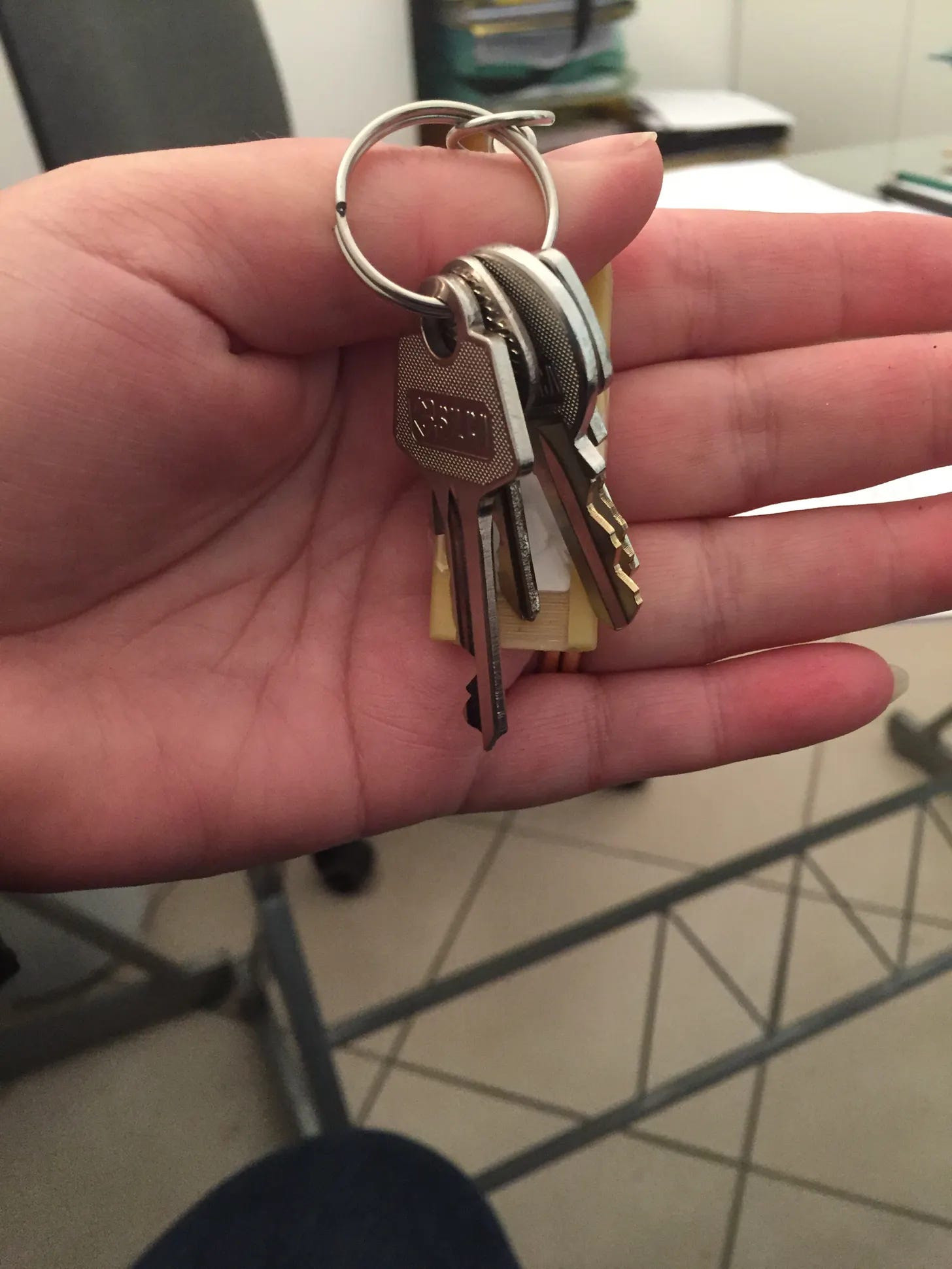
A hotel gives you a bed and a breakfast and insulates you from exactly the things you need to learn: how the appliances work, how the heating system works, how to manage garbage collection days, how to navigate a lease or a rental agreement in Italian
In smaller cities, AirBnB options may be limited. This is where the tourist office comes in again — they often maintain lists of short-term rental possibilities that never make it onto the major platforms. Ask them directly. Explain what you are doing. Italians generally respect a person who is doing things properly.
The Thing About Family Gravity
For us, the decision was ultimately made by something that cannot be replicated by a checklist: the pull of a name, a place, a history. The Zanrè family is from Borgotaro. Joe felt it the moment we arrived. No amount of comparative analysis of other towns was going to outweigh that. Ultimately we DID try it out in a manner of speaking, by doing the Schengen Shuffle for almost 18 months. You can read about that here!
But most people making this move do not have that anchor. They are choosing on spec — weighing livability, cost, climate, community, proximity to airports, quality of healthcare — and for those people the reconnaissance trip is not optional. It is the decision.
Go before you commit. Stay long enough to be bored, to be frustrated, to be delighted by something ordinary. Stay long enough to have a favorite bar and a regular vendor at the market who recognizes you.
That is how you know.
