Your American Cards Won't Always Work in Europe (And What to Have Instead)
We arrived in Italy in 2016 with roughly €5 between us and not one ATM that would accept our cards. A decade later, the banking landscape for Americans in Europe has changed considerably — and in some ways, gotten more complicated.
This post contains affiliate linksWe arrived in Italy for what would become our permanent move with roughly €5 between us. I know.
We had every intention of hitting the first ATM we saw, but that somehow kept not happening until we finally ended up in Parma, exhausted from the flight and two trains, ready to get cash and start the final leg of our trip to Borgotaro. What followed is one of those travel moments that is absolutely not funny while it is happening and gradually becomes the story you tell at dinner parties for years.
Not one ATM would take my card. Not my PayPal debit. Not my bank debit. We were, by any practical measure, cashless in a country where we did not yet properly speak the language, with a hotel room to pay for.
At the train station in Malpensa, I had already gotten a preview of what was coming. We had to go to the ticket window to buy our train tickets because the machines would not accept our cards. Most of our cards had chips, but they were "chip and sign" rather than "chip and PIN" — and European automated systems simply do not recognize that distinction gracefully. Later, I called the bank and they fixed everything. But our first hours in what would become our home were, let's say, more stressful than we'd hoped. (Understatement fully intended.)
That was 2016. A lot has changed since then — our cards have long since been sorted, and the banking landscape for Americans in Europe has shifted considerably. But the underlying problem is still very much alive, and in some ways it has gotten worse. After a decade of navigating this on the ground, here is what I know.
The Cards Americans Bring (And Why Some No Longer Work)
Visa and Mastercard are the most widely accepted card networks in Europe. If you have a credit card on either of those networks with a chip (which virtually all American cards now have), you will generally be fine at merchants. Debit cards are more complicated.
Here is something that has blindsided a lot of Americans recently: Capital One, which had been a genuinely excellent option for international travelers because of its no-foreign-transaction-fee policy, switched all of its checking debit cards from the Mastercard network to the Discover network. This was not announced with great fanfare. Many people found out when their cards stopped working.
Discover has perfectly reasonable acceptance in the United States. In Europe, it is quite limited. American Express has the same problem. The on-the-ground reports from Americans traveling and living abroad are consistent: Discover debit cards do not reliably work at European ATMs. Even Capital One's own help pages now suggest researching acceptance before travel and bringing a backup payment method. One traveler on a popular Europe forum reported finding exactly one ATM in Munich that accepted Discover — and it had a five-dollar withdrawal limit.
If your Capital One debit card is your primary banking card, please read the rest of this post carefully. You have options.
Apple Pay and Google Pay: Better Than You Might Expect
The contactless payment landscape in Italy has improved substantially. Most places that accept cards also accept Apple Pay and Google Pay now. This is true even in smaller towns. (Even churches now have contactless donation boxes, which continues to delight me.)
That said, Apple Pay is only as useful as the card loaded into it. If the underlying card is on the Discover network, contactless payment may still go through in some situations — but you should not count on it for cash withdrawals, which is a different problem entirely.
There is also a cultural note worth making here. I still try to pay with cash for anything under about €10, particularly at small, family-run places. Small merchants pay a percentage on every card transaction, and on a €1.50 coffee, that percentage is not nothing. I have watched visitors tap their phones for a single espresso, and while I understand the impulse, being a good neighbor sometimes means pulling out a coin.
What Actually Works: Three Accounts Worth Knowing
Wise (formerly TransferWise)
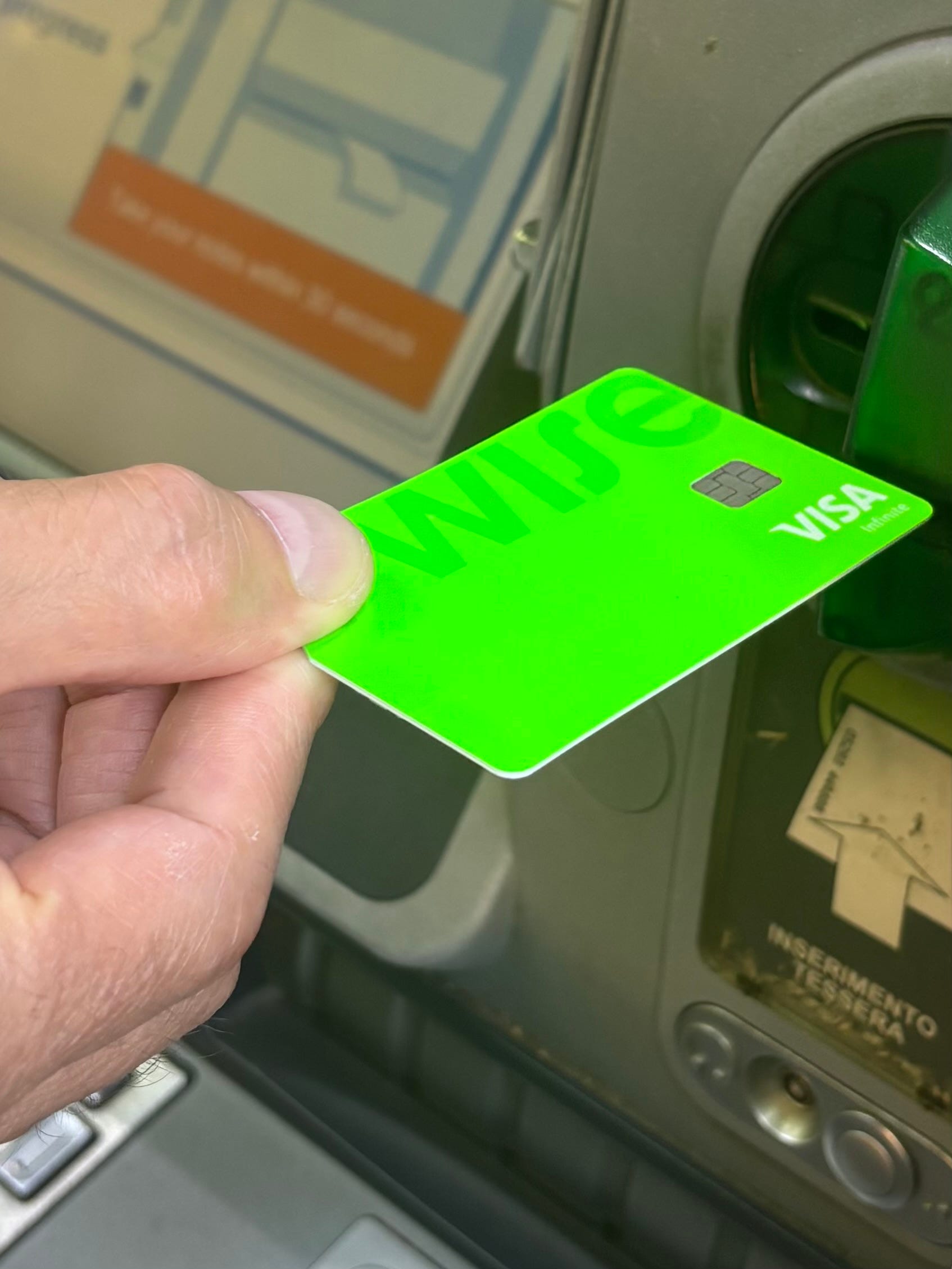
If there is one account I would tell every American heading to Europe to set up before they board the plane, it is Wise. We have had accounts since 2016, when it was still called TransferWise.
The origin story of Wise is genuinely worth knowing because it explains exactly why it works the way it does. Two Estonian friends, Kristo Käärmann and Taavet Hinrikus, were both living and working in London, but each had financial obligations back in Estonia. Kristo was earning British pounds but had a mortgage back home that needed to be paid in euros. Taavet had a salary being deposited in Estonia but needed pounds for his London life. Both were losing money every month to bank exchange fees and exchange rate markups.
Their solution was wonderfully direct: instead of each paying banks to move money across borders, they would just do local transfers for each other. Taavet would transfer euros from his Estonian account to Kristo's Estonian account. Kristo would transfer pounds from his London account to Taavet's London account. They used the mid-market exchange rate — the real rate, the one you see on Google, not the marked-up version banks offer — to calculate what each owed the other. No international transfer. No fees. No markup.
They launched TransferWise in 2011 because they realized thousands of people had exactly the same problem. In 2021, the company went public on the London Stock Exchange, and Käärmann and Hinrikus became Estonia's first tech billionaires. The company has since rebranded to simply Wise.
What this means practically: Wise functions as a multi-currency account. You can hold US dollars, euros, British pounds, and more than 50 other currencies simultaneously. The Wise debit card works at ATMs and merchants throughout Europe, converting from whatever currency you hold at the real mid-market exchange rate with a small, transparent fee — almost always better than what your American bank would charge. My husband has his Social Security deposited into his US dollar account at Wise, and we can access those funds anywhere in Europe without drama.
I have also paid virtual assistants in the Philippines, Croatia, and elsewhere through Wise. The fees are generally better than PayPal, and after several of my VAs looked into it for themselves, they opened Wise accounts just for the savings on their end.
One important caveat: Wise is not a bank. It is not FDIC insured. We do not keep a large balance there, but for day-to-day transactions and international transfers, the debit card works beautifully. Sign Up Here!
Revolut
Revolut is similar to Wise in its core function as a multi-currency account with a debit card that works well in Europe. Where it differs for people actually living in Italy is that Revolut can hold an Italian IBAN — an Italian bank account number in the European standard format — which means you can make Italian bank transfers and, crucially, pay your taxes through the F24 system. This is significant if you are not just visiting, but actually living here.
Many Italian residents, both Italian and foreign, prefer Revolut for exactly this reason. It is also worth noting that Revolut has been expanding its banking license coverage in Europe, which changes its regulatory protections compared to Wise. Worth investigating for your specific situation.
N26
N26 is a German-founded bank with a full banking license operating throughout Europe. Before I had Italian citizenship and access to Italian banking, N26 was my European bank of preference. It offers an Italian IBAN option and functions as a proper bank account in a way that the other two do not always manage.
The limitation I last encountered is that N26 could not process Italian tax payments through the F24 system — a material gap if you are a resident here. Banking regulations evolve, so verify the current situation before relying on N26 for tax compliance. But for a foreign resident who needs a proper European IBAN and a card that actually works, it is a solid option. Sign up Here!
Curve Card
The Curve Card is a bit different. You can almost think of it like Apple Pay or Google Pay. You can load all of your cards on the Curve Card, turn them on and off through the app, and use the actual Curve Card to pay your bills. I had mine before Apple Pay was widely accepted in our town, and it was great. What's REALLY great is if you are living in Europe, and receive a debit or credit card in the US, and will not be able to use the card until you get it in your hands in Europe. This is also very much like in Apple Pay or Google Pay. The benefit is that you have a physical card for those places where nothing but a physical card will work. Curve is not available for any residents outside of the UK and the European Economic Area (EEA). Thus, this is not a card for North Americans, but it can accept cards to be loaded that are issued in North America. Sign Up Here!
The Short Version
If you are visiting Italy or Europe:
Bring a Visa or Mastercard credit card with no foreign transaction fees
Get a Wise account and debit card before you leave home
Carry a reasonable amount of cash for small purchases and emergencies
If your primary debit card is on the Discover or Amex network, do not count on it as your only ATM option
If you are moving to Italy:
Start with Wise for day-to-day spending and international transfers
Look at Revolut if Italian tax payments are a factor
Consider N26 if you want the security of a fully licensed European bank account
Know that eventually you will probably want an actual Italian bank account, which is its own adventure — but you will at least have backup options while you navigate the bureaucracy
We have come a long way from standing in Parma with €5 and a pile of luggage. But the cards situation is still not intuitive, and it still catches people off guard. Hopefully this saves someone from standing at a Bancomat willing it to work through sheer force of personality. (It does not work. I have tried.)


