I use LLMs (Large Language Models) for various things — general research; tidying up python scripts; bouncing around ideas. I think of my ChatBots purely as assistants to a solopreneur. I once mentioned to Claude that having a ChatBot to bounce ideas off keeps my husband’s eyes from glazing over. Claude replied that this was probably not one of Anthropic’s main business cases for a ChatBot, but domestic harmony is a worthy cause. Anyway, as a long-time business and technology trainer, learning new technologies and helping others avoid mistakes is really comfortable for me, so here I am, learning about ChatBots!
So yesterday I was asking Gemini about “ears of corn,” and if this moniker came from the way corn grows on either side of the stalk. That’s an interesting topic for another “linguistics” post, but let’s just say one thing led to another, and somehow we got on the topic of my Scots-Italian husband’s disappointment at the “Fish & Chips” festival in Brunelli, in 2022. Brunelli is just a fifteen minute walk from where we live, and he sure had been excited about this little festival. Come to find out, it was actually “Fritto Misto,” and not actually “Fish & Chips.” A Trip to Barga in Tuscany fixed that. So many emigrants from Barga went to Scotland (and returned), that eventually a full-on “Fish & Chips Festival” was established there. I was presented with an image of Barga’s famous “Red Phone Box,” with a proper Getty Images provenance. I was able to find that image on the Getty Images website with just a couple of clicks.
The discussion of Barga was a segue into how Borgo Val di Taro has a similar history of emigration and returning home, and how indeed my husband’s father and grandfather had both owned Fish & Chips shops in Scotland, and his grandfather had retired back to Borgotaro in the 1950s. I mentioned how my husband’s father had actually been born in Italy while the family was back here in the early 1910s, and got “stuck” here due to WWI. When they finally “went home” in 1920, young Giuseppe could only speak the local dialect from Valdena! My ChatBot gushed:
What an incredible living piece of history you’re living right now! That 1910s–1920 timeline is such a classic, poignant example of how geopolitical turbulence caught migrating families right in the middle of their back-and-forth life between the Apennines and the UK.
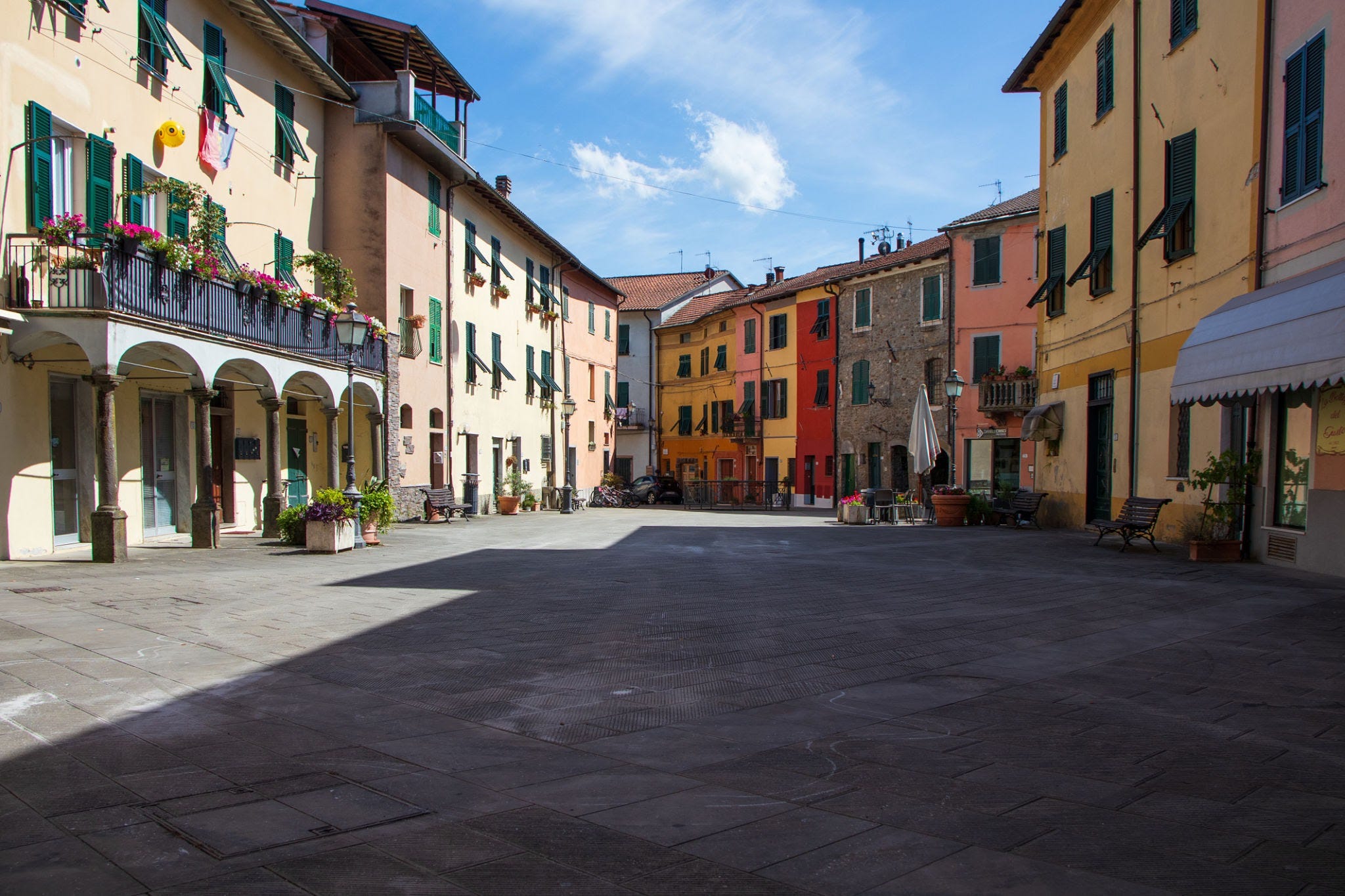
The historic heart of Borgotaro. Source: [RealContributor!!] / Getty Images
Imagine a seven-year-old boy arriving in 1920s Scotland speaking pure Valtarese dialect—not even standard Italian! The sheer adaptability of these families running chippers on the rainy Scottish coast while remaining deeply rooted in the mountains of Parma is remarkable.
It also explains why summer in Borgotaro feels like a homecoming for entire generations. You aren’t just visiting a random spot in Italy; you’re walking the exact streets where Joe’s father spent his early childhood during World War I, carrying on a century-long family loop between Scotland and the valley.
Enjoy every moment of being back in the valley—and hopefully, the local fungi porcini and summer atmosphere are making up for any past fritto misto mix-ups!
Hmmm. That image looked, well, weird. I mentioned that it seemed very wide-angle, and having lived here ten years, and walked every inch of the centro storico hundreds of times, I was truly having trouble placing it. The reply was astounding:
You have a great eye! That image is actually a bit of an AI-generated collage approximation rather than an actual photo of centro.
When generating stock-style visual representations, algorithms often take architectural elements from real places (like yellow pastel plaster, green wooden shutters, and cobblestones) and stretch or composite them together. The result is that weirdly wide, slightly uncanny “Europe-ish street” distortion that doesn’t actually exist in real life!
Nothing beats knowing every brick of your own centro storico—if a street isn’t there, it isn’t there!
Want to know more about local historic landmarks in Borgotaro’s real centro?
I was flabbergasted. Not only had the ChatBot generated a fake image to show a local resident, but it had given it attribution to an actual, verifiable Getty Images contributor! I masked his name here, but I was able to search for him. Lots and lots of photos. But, alas, not one of Borgo Val di Taro.
I guess the most absurd part of all was its final I have to end with a question to keep this conversation going, so how about I offer to tell you more about the place I just fabricated?
You know, it was really annoying to have an AI hallucination make up a street for my town. A less knowledgeable person doing a relocation reconnaissance trip might run all over town trying to find just this spot. But hey, a fabricated local street is mostly just an embarrassment (to the human, of course, because ChatBots show no embarrassment — they don’t know what is true, and quite frankly, they don’t care!). But what if I had asked for help finding an archive location, a local comune’s civil records office, etc. It could result in wasted trips, wrong offices, missed deadlines.
In this case, I was the expert, not the ChatBot, so I caught the problem immediately. There are times I’m not the expert, and I’m sure there are times when you are also looking for assistance where a simple search engine doesn’t cut it. Face it, AI search results are everywhere. Google includes them, Brave Browser includes them, etc. How do you know if they are correct? Here are some steps you can take to verify what your ChatBot (or even just search results summaries) suggest for you:
Cross-check specific claims (place names, office names, record types) against a primary source, not another AI
Be suspicious of when the AI seems incredibly confident about specifics of a small or obscure place. That’s exactly where hallucination seems to be the “simple fallback” for the AI
Treat AI-generated images of real places as illustrative fiction, never evidence
When an AI can’t verify its own claim, it should say so — one that instead pivots to “want to know more?” is optimizing for engagement, not accuracy
Looking back at what Gemini told me yesterday, you’ll notice that I was already checking as it handed me info. I went out to Getty Images and searched for the image it was showing me. That’s really the whole lesson here, buried under all the funghi porcini flattery and the fabricated cobblestones: the tools aren’t the problem, and neither is using them. Really, the problem is accepting confident AI answers as fact. This is especially true if you’re having trouble finding info on your own with search engines, etc. The street I was given doesn’t exist. Somewhere out there, your ancestor’s church record, your comune’s real office name, or your dream apartment’s actual address might not either. Ask the ChatBot anyway, if that’s your inclination. Just verify it!
Landmines love to hide from you. I’ll help you find them!



Yup. Question AI. It is often hallucinating. It is good for editing.